
Mindfulness – Not Just for Hippies

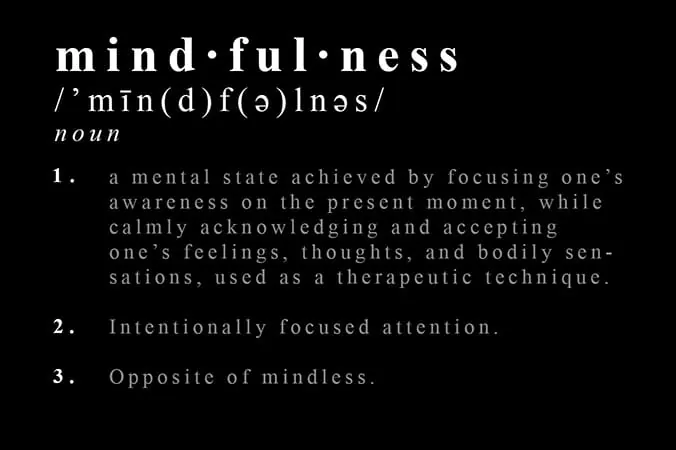
white text on black background depicting the definition of Mindfulness

Mindfulness is a buzzword right now. It calls up images of “seekers” sitting cross-legged and touching their fingertips. Which might turn off a lot of people.

But don’t be so quickly detoured.

Because practicing mindfulness doesn’t have to look like this and it can be really beneficial.

And it’s free.

You can practice mindfulness anywhere, any time

Quite simply, mindfulness can be noticing the taste of your food, noticing which muscles you’re using when you work out, or noticing when you’re really tired and taking a break.

Technically in a practice, mindfulness is the optimal interaction between intentionally focused attention and peripheral awareness. You can focus on your breath or your thoughts. You can focus on any of your five senses, what you’re doing at any given moment or anything you want.

The point is to choose one thing to focus on and sort of ignore everything else, but don’t block it out.

It’s kind of like when you’re home with the kids and trying to get some work done. You’re keenly focused on the task at hand, but always aware peripherally of what your kids are doing, what’s going on in the house and outside the house; but not getting involved in all that.

The same is true if you work in a busy office. Phones are ringing, deals are being made but you are intently focused on the work you must get done, while maintaining a peripheral awareness of what’s going on around you but not getting distracted by it.

“Mindfulness practice is the optimal interaction between focused attention and peripheral awareness”
John Yates, PhD

Practicing this daily for a set amount of time eventually trains your mind to quiet down at will.

Mindfulness practice is energy efficient

Many people work all day in an office crunching numbers, drafting floorplans, doing research, or filing documents. While this work is not physically taxing, at the end of the day you can be exhausted. Mental work requires energy. And for most of us, that mind of ours is constantly solving problems, preparing for the future, examining the past, questioning our actions and the actions of others. Worst case scenario, we’re ruminating, berating ourselves and others. All of this thinking takes energy that could be used for something else in our body. Like rest and repair of our immune system, etc.

A regular mindfulness practice eventually trains you to become aware of how you’re spending your mental energy and optimizing that mental landscape. Instead of passively accepting a crummy mindset, you’re actively improving it, day by day, one session at a time.

Generally speaking, there are two models for cultivating mindfulness in the context of meditation practice—a 2500-year old historical model that is rooted in Buddhist science and a 25-year old contemporary model that is heavily influenced by Jon Kabat-Zinn’s Mindfulness-Based Stress Reduction (MBSR) course, an adaptation of specific Buddhist techniques intended for general stress reduction (Kabat-Zinn, 1990). The historical model for training the mind has similar goals to the contemporary western medical model: both are interested in reducing suffering, enhancing positive emotions, and improving quality of life.

Vago and Silbersweig (2012)

“I can’t stop ruminating”

Sometimes it feels impossible to quiet your mind. In fact, it can be troubling. That’s when psychotherapy is useful.

A psychotherapist is literally someone who is trained to focus attention on your mental state and patterns while being peripherally aware of everything you say and do.

Psychotherapy is like doing a mindfulness practice with a professional guide. Because mindfulness is all about improving your mind to do what you want in life.


Want some help?

If you’ve tried mindfulness and you’re running into some problems, give me a call. We’ll talk.

Photo of Leah Benson, LMHC

Leah Benson, LMHC is a licensed psychotherapist in private practice in Tampa, FL

Leah Benson Therapy icon

Share this article

Get your anger under control today with an experienced anger management counselor.

REQUEST A FREE COPY OF THE INTRODUCTION OF

EMOTIONAL UTOPIA

Just tell me who you are...

leah benson on mobile phone zoom meeting

Online
Therapy
Available

This website uses cookies to ensure you get the best experience on our website. By continuing to browse on this website, you accept the use of cookies for the above purposes.